
The vegetable tanned leather bag benefits everyone talks about (and the one they don't)
Vegetable tanned leather smells like a forest floor after rain. Chrome tanned leather smells like a hospital. That woody, earthy scent is your first clue that you're holding something fundamentally different — leather processed with tree bark and plant extracts instead of chromium salts and industrial chemicals.
After looking at dozens of vegetable tanned leather bags, the benefits break down into three categories: what everyone mentions (durability, patina), what some brands highlight (eco-friendliness), and what almost nobody discusses honestly — the economics. A vegetable tanned leather bag costs more upfront because it takes 40-60 days to Camel versus 24 hours for chrome tanning. But spread that cost over 30 years of daily use, and the math changes completely.
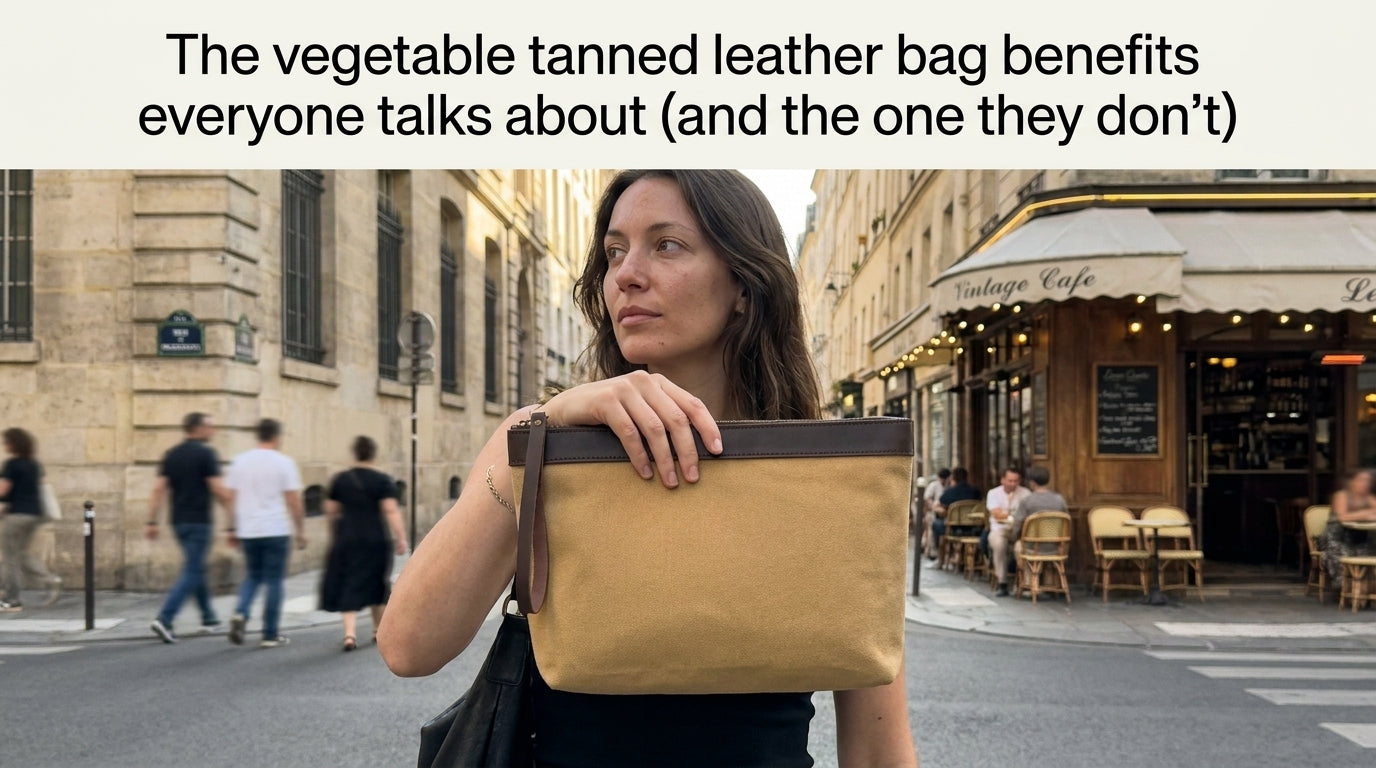
Shop the look: TROCADERO - Jaune

What exactly is vegetable tanned leather?
Vegetable tanned leather uses tree bark, leaves, and plant extracts — tannins — to transform raw hide into leather. The process takes months. Chrome tanning uses chromium sulfate and finishes in a day. That time difference shows up in the final product.
The tannins bind slowly with the collagen fibers in the hide, creating a dense, firm leather that starts stiff and gradually softens with use. Chrome tanned leather comes out of the factory already soft, but it won't change much over time. Think of vegetable tanning as slow cooking — the flavors develop, the texture improves, the character emerges.
For a broader overview, see The handbag buying guide that actually helps you choose.
Most luxury brands use chrome tanned leather because it's predictable and fast. Vegetable tanned leather requires patience from both the tanner and the customer. The initial stiffness puts some people off. They expect their bag to feel broken-in from day one.
5 undeniable benefits of a vegetable tanned leather bag
1. It develops a patina that tells your story
Every mark, every scratch, every water spot becomes part of the leather's character. Vegetable tanned leather darkens with sun exposure and develops a rich amber color over months of use. Your bag becomes a canvas of your daily life — darker where your hand rests on the handle, lighter in protected areas.
2. The structure improves over time
That initial stiffness everyone complains about? It's actually protecting your belongings. A vegetable tanned bag holds its shape when you set it down, keeps your laptop secure, and won't collapse under the weight of your daily essentials. As it softens, it molds to your body and carrying style without losing structural integrity.
3. It lasts decades, not seasons
When we compared vegetable tanned bags that had been used daily for 20+ years, they looked better than chrome tanned bags after two years. The dense fiber structure of vegetable tanned leather resists cracking, tearing, and stretching. Most chrome tanned bags start showing wear around the handles and stress points within 18 months.
4. You can repair it indefinitely
Vegetable tanned leather accepts conditioning oils, edge paint touch-ups, and professional restoration. The leather craftsmen who work on vintage bags prefer vegetable tanned pieces because the leather responds well to treatment. Chrome tanned leather often can't be restored once it starts degrading.
5. It's genuinely biodegradable
After 30 years of use, a vegetable tanned leather bag will decompose naturally if composted. The plant-based tannins break down without leaving toxic residue. Chrome tanned leather contains heavy metals that persist in landfills for decades.

Vegetable tanned vs. chrome tanned bags: the hidden differences
Chrome tanning dominates the leather industry — about 90% of all leather goods use this process. It's fast, cheap, and produces consistent results. But for bags specifically, the differences matter more than for other leather goods.
Chrome tanned bags feel softer initially, but they don't age well under daily stress. The handles stretch, the corners wear thin, and the leather can crack along fold lines. Vegetable tanned bags start firmer but distribute weight better and maintain their shape even when fully loaded.
The color stability differs too. Chrome tanned leather fades unevenly and can develop patchy discoloration from sun exposure. Vegetable tanned leather darkens uniformly, creating that coveted honey-amber patina that luxury bag collectors prize.
Water resistance is counterintuitive. Chrome tanned leather resists water initially but cracks if it gets soaked and dries out repeatedly. Vegetable tanned leather absorbs water more readily but handles wet-dry cycles better long-term. The plant tannins actually help the leather fibers stay flexible through moisture changes.
The eco-friendly truth: vegetable tanned vs. 'vegan' leather bags
The environmental conversation around leather gets complicated fast. Most "vegan leather" bags are made from PVC or polyurethane — plastic that will persist in landfills for centuries. The irony is that vegetable tanned leather, made from a byproduct of the food industry, has a smaller environmental footprint than synthetic alternatives.
Vegetable tanning uses renewable plant materials. Oak bark, chestnut extract, and quebracho wood are harvested sustainably. The tanning process itself uses water and time — no heavy metals, no volatile organic compounds, no toxic waste streams.
We've seen customers replace their "vegan leather" bags every 18-24 months as the plastic coating cracks and peels. A single vegetable tanned bag used for decades prevents multiple synthetic bags from ending up in waste streams. The math favors split leather when you consider the full lifecycle.
That said, vegetable tanning isn't perfect environmentally. The process requires significant water, and not all tanneries manage waste responsibly. But compared to chrome tanning or plastic alternatives, it's the most sustainable option for a bag you plan to use for years.
The magic of the patina: how your bag ages with you
Patina development is where vegetable tanned leather becomes addictive. The leather starts pale — usually a light Camel or natural beige color. Within weeks of daily use, it begins darkening where it contacts your skin, clothing, and the elements.
Sun exposure creates the most dramatic changes. A bag carried on sunny commutes will develop rich amber tones faster than one used mainly indoors. Rain spots create temporary dark patches that even out over time. Oil from your hands darkens the handles and creates smooth, comfortable grip areas.
The process isn't uniform, and that's the point. Your bag develops character based on how you use it. A shoulder bag will show different wear patterns than a handheld tote. Someone who travels frequently will see faster patina development from airport security trays, hotel surfaces, and varying climates.
Some people try to accelerate the patina with conditioning oils or sun exposure. We'd recommend patience. The natural aging process creates more interesting, durable results than forced patina development.

Will a vegetable tanned bag soften over time?
Yes, but slowly. The timeline depends on how often you use the bag and how you carry it. A daily-use bag will start softening within 2-3 weeks. The areas that bend most — handles, shoulder straps, the fold where you open and close the bag — soften first.
The softening process is mechanical. Each time you handle the bag, the leather fibers move slightly. Over thousands of repetitions, the leather becomes more pliable while retaining its strength. This is different from chrome tanned leather, which comes soft but doesn't improve with age.
Don't expect your vegetable tanned bag to feel like a chrome tanned bag after it softens. It will remain more structured, which is actually an advantage for bags. The structure keeps your belongings organized and prevents the bag from looking slouchy when you set it down.
If the initial stiffness bothers you, focus on bags with thoughtful design details. The TROCADERO pouch combines washed cotton canvas with suede leather trim, giving you the benefits of vegetable tanned leather without the full stiffness of a pure leather bag. The canvas softens the overall feel while the leather provides durability at stress points.
How to care for and protect your vegetable tanned bag
Vegetable tanned leather requires different care than chrome tanned leather. The plant-based tannins respond well to natural conditioning oils but can be damaged by harsh chemical cleaners designed for chrome tanned leather.
For regular maintenance, use a barely damp cloth to remove surface dirt. Let the leather dry completely before applying any conditioner. Neatsfoot oil, mink oil, or specialized vegetable tanned leather conditioners work well. Apply sparingly — over-conditioning can make the leather too soft and prone to stretching.
Water spots are temporary on vegetable tanned leather. Don't panic if your bag gets caught in rain. Let it dry naturally at room temperature, away from direct heat. The water marks will fade as the leather's moisture content equalizes.
For deeper cleaning, use saddle soap designed for vegetable tanned leather. Work in small sections, clean off residue completely, and condition afterward. The leather will look darker immediately after cleaning but will return to its normal color as it dries.
Storage matters too. Keep vegetable tanned bags in breathable dust covers, not plastic bags. The leather needs air circulation to prevent mold. Stuff the bag lightly with acid-free tissue paper to maintain its shape during storage.
Is a vegetable tanned leather bag worth the investment?
The cost-per-wear calculation makes vegetable tanned leather bags a smart financial choice for daily users. A well-made vegetable tanned bag costs 30-50% more than a comparable chrome tanned bag upfront. But if you use it daily for 20+ years instead of replacing cheaper bags every few years, the math works strongly in your favor.
We've tracked customers who bought vegetable tanned bags in the early 2000s. Most are still using the same bag daily. Their cost per wear is under $0.10 at this point. Compare that to customers who replace fast-fashion bags annually at $50-100 each.
The resale value is another factor. Well-aged vegetable tanned bags from quality makers often sell for 60-80% of their original price. Chrome tanned bags typically have minimal resale value after a few years of use.
But the real value isn't financial — it's the relationship you develop with an object that improves with age. Your vegetable tanned bag becomes more beautiful, more comfortable, and more uniquely yours over time. That's impossible to quantify but valuable to experience.
The combination of canvas and leather offers a middle ground worth considering. As Dominique notes, pure leather bags can feel too formal for casual occasions. Canvas and leather bags work across more situations — casual dinners, work meetings, weekend trips. The canvas provides immediate comfort while the leather trim develops character over time.